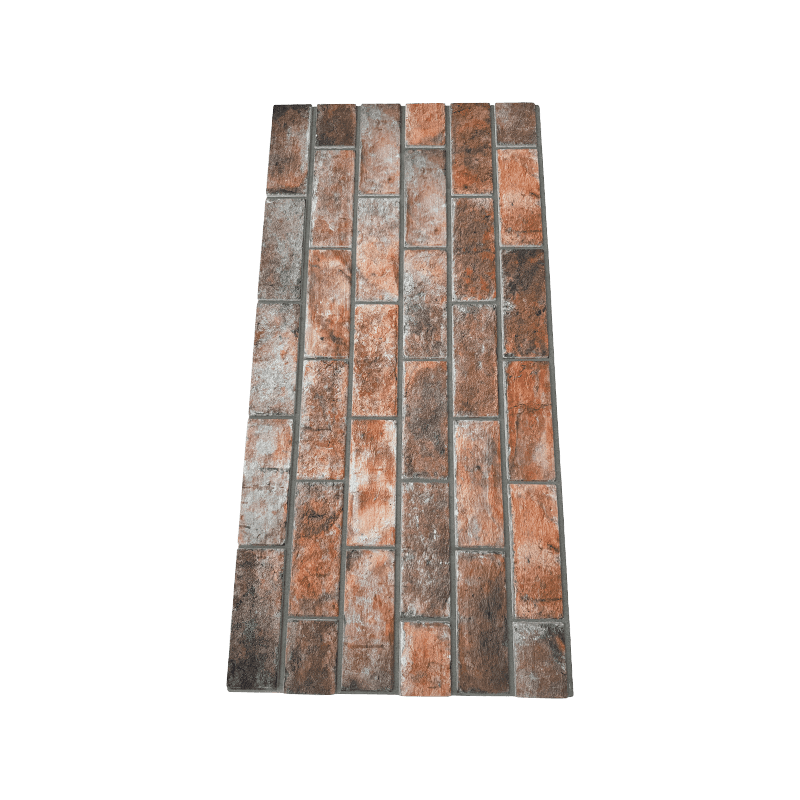
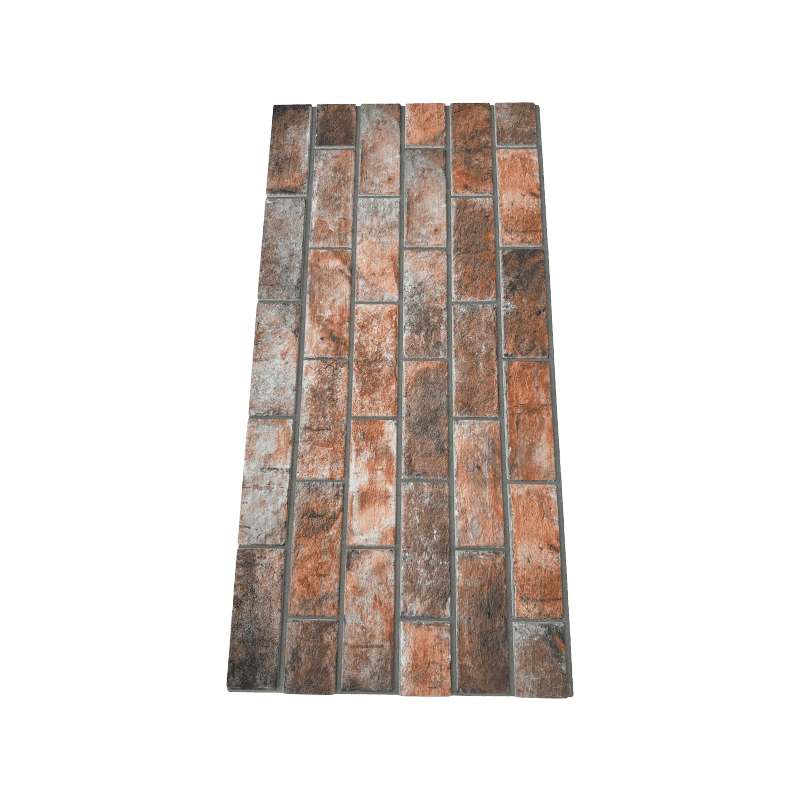
Yicheng New Materials Co., Ltd. produces EPS faux brick wall panels for distributors, importers, contractors and project partners who need a lightweight decorative cladding that installs without mortar. Since 1998 we have manufactured interior and decorative building materials in Haining, Jiaxing, Zhejiang, and our current range covers PVC ceilings and walls, SPC flooring, PU decor, flexible stone, films and accessories alongside this panel family.
Our EPS Brick Wall Panel, Styrofoam Brick Panel OEM/ODM Suppliers line is built around a 1000 × 500 × 25 mm panel with an EPS foam core and a laminated decorative surface embossed with brick, culture stone or antique brick textures. We produce it on our panel lines in a 30,000 m² facility with 30+ production lines, and we supply it with OEM/ODM color matching, packaging and marketing support. The range serves residential accent walls, hotel and guesthouse refurbishment, retail feature walls, corridor wainscoting and urban facade renewal where low weight and fast dry installation matter.
What Our EPS Brick-like Wall Panel Range Covers
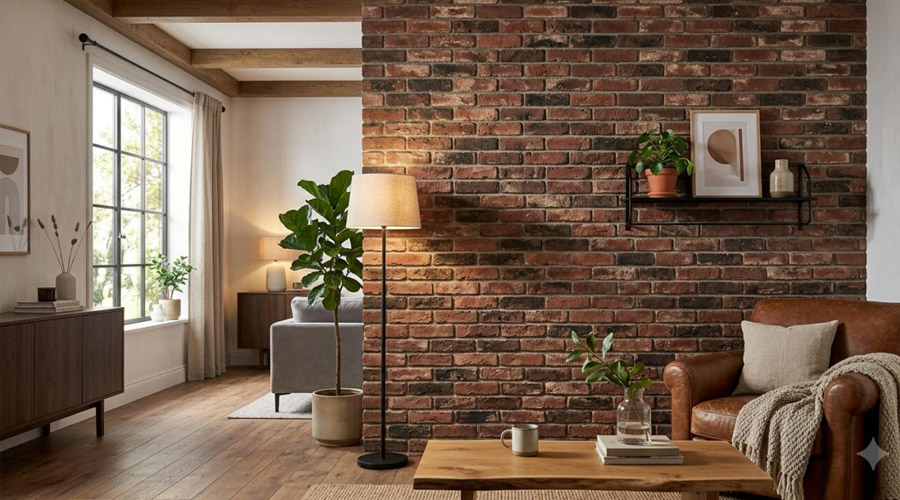
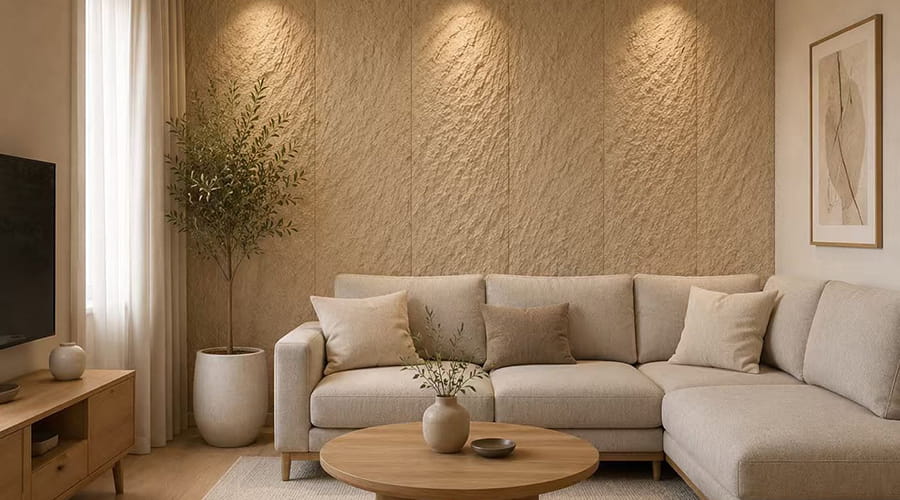
The core product is the 1000*500mm EPS Brick-like Wall Panel, a 25 mm tongue-and-groove panel with a laminated film face. Surface textures include red brick, antique brick and culture stone, embossed at 0.5–1.0 mm depth to reproduce mortar joints and stone relief. Panels are cut with a utility knife, jigsaw or hole saw, and cut edges are clean enough for interior use without sealing.
Because the decorative effect comes from the laminate rather than from fired clay, the same panel format can carry different brick layouts, stone looks and brand-specific colors. That gives distributors a way to build a local wall-cladding program around one panel construction with several visual SKUs, and it gives project teams a consistent texture across phases of a renovation.
Technical Profile of the 25 mm EPS Panel
| Property |
Specification |
Project Relevance |
| Panel size / thickness |
1000 × 500 × 25 mm |
0.5 m² per panel; simple area take-off |
| Weight per unit area |
Approx. 4–6 kg/m² |
Low dead load on walls and frames |
| Core composition |
EPS 18–22 kg/m³ + polymer laminate |
Closed-cell core, stable panel shape |
| Thermal conductivity |
≤0.041 W/(m·K) |
Reduces thermal bridging on walls |
| Fire performance |
Class B1, self-extinguishing |
Surface chars, self-extinguishes on flame removal |
| Moisture behavior |
Wet expansion ≤0.1%; contact angle ≥90° |
Humid interiors and sheltered exteriors |
| Temperature range |
-30 °C to 70 °C |
Cold-chain facades, hot climates |
| Chemical resistance |
48 h in 5% H₂SO₄ / NaOH, no blistering |
Retail and service-area walls |
Application Fit Across the Range
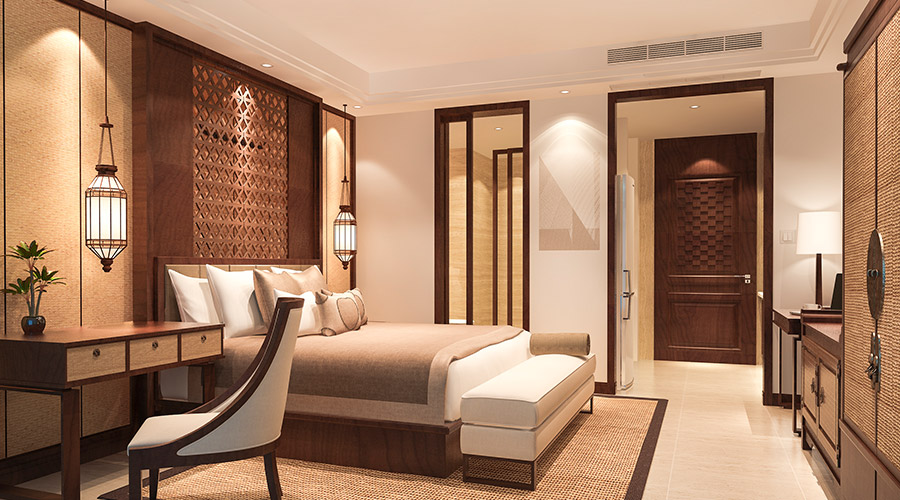
Brick and stone textures work hardest where a wall must read as masonry but cannot carry masonry. Our panel suits interior TV walls, headboards, corridor wainscoting and basement walls, and it also handles sheltered exterior faces such as shopfront surrounds, urban renewal facades and self-built house exteriors. Hospitality projects — guesthouse rooms, hotel lobbies, restaurant theme walls and retail displays — use the antique brick and culture stone textures to set a room's character without wet trades.
The range also covers temporary and fast-turnaround needs: exhibition booths, showroom model units and site hoarding. In dry bathroom zones and kitchen walls away from cooktop heat, the laminate barrier resists moisture and cleans with a damp cloth and neutral detergent. Where a project mixes brick panels with flat sections, we also supply complementary wall panels, PVC square tubes for edge and corner treatment, and accessories such as profiles and trims to finish junctions.
Installation Method and Site Conditions
Panels join by side-edge tongue-and-groove or clip interlock and fix with adhesive backing or mechanical fasteners. There is no mortar, no sand, no curing period and no brick handling; a single panel takes roughly 30–45 seconds to set once the wall is prepared. The substrate must be flat within 5 mm over 2 m, sound and free of loose material. For exterior applications above 10 m, we recommend additional mechanical fasteners or mortar adhesive to resist wind pressure, together with a UV-stabilized exterior laminate.
Cut edges need no sealing for interior work. On exterior faces, seal cut edges to stop capillary water absorption. Cleaning is dry: a soft brush or vacuum with a brush attachment, then a damp cloth with diluted neutral detergent at 1:50 for local marks.
OEM/ODM Configuration We Support
- Texture and pattern: brick, antique brick and culture stone embossing; brand-specific patterns reproduced through HD digital printing with batch-to-batch texture consistency.
- Color: custom color matching against Pantone references or physical swatches, developed as pre-production samples before mass production.
- Material performance: fire resistance rating, wear resistance and antibacterial properties tailored to the commercial application.
- Dimensions and edge details: panel size, V-groove, hidden clip and curved profiles for integrated designs.
- Packaging and brand: export-standard packing, private-label cartons and printed marketing materials, catalogs and specification sheets.
Quality Control and Acceptance
Incoming resin, additives and decorative films are inspected for environmental grade and physical strength before production. Patrol inspection during the run monitors process parameters and surface condition. Before delivery, finished panels go through a standard inspection procedure with bending as the key test — the board resists bending without breakage — followed by impact, hardness, wear and dimensional checks. Finished goods are also tested for waterproofing, flame retardancy, anti-aging and corrosion resistance.
We retain a first-batch sample for each item and compare every later batch against it on appearance, color and texture, which keeps repeat orders visually consistent. Inspection reports and inspection photos can be provided with shipment. The fire class, mold resistance and thermal values in the table above follow the referenced GB test methods, and technical documents are supplied with the order for submission to local authorities.
Project Logistics and Serviceability
Our export volume runs at 1,500+ 40HQ containers a year, mainly to Latin America, Africa and Europe. Panels are light and stack efficiently, so a container carries a large finished wall area; we pack to export standard and supply shipping documents with each order. Free samples are available for quality and market reference, with international freight paid by the customer; we assist with sample consolidation and freight quotation. Spare panels from the same production batch are the practical maintenance route for damaged sections, since a matched texture and color can be swapped in without reworking the wall.
Information We Use to Configure Your Solution
| Input |
What It Determines |
| Application and wall area |
Panel quantity, texture direction, trim quantities and packing plan |
| Interior or exterior exposure |
Standard versus UV-stabilized laminate; fastener and sealing recommendation |
| Texture and color reference |
Embossing pattern, digital print artwork and sample development |
| Substrate condition and mounting height |
Adhesive versus mechanical fixing; exterior wind-pressure measures |
| Fire, moisture and cleaning requirements |
Core and laminate specification; chemical resistance confirmation |
| Volume, packaging and brand materials |
Production scheduling, private-label packing and catalog preparation |
Send the wall drawings or area schedule, the exposure condition and a texture reference, and we will return a panel and trim configuration with a sample plan. Distributors working toward a full interior program can also review our product range for ceilings, flooring and decor that ship alongside this panel.
Frequently Asked Questions
Can EPS brick panels be installed directly on exterior walls?
Yes, when the substrate is flat within 5 mm over 2 m, sound and free of loose material. For exterior walls above 10 m we recommend additional mechanical fasteners or mortar adhesive to resist wind pressure, and an exterior-grade UV-stabilized laminate rather than the standard interior film.
What does Class B1 fire performance mean in use?
The panel surface chars when exposed to open flame and self-extinguishes within about 3 seconds after the flame is removed, with no molten drips that could ignite material below. The panel should not be exposed to open flame or sustained temperatures above 150 °C.
How are panels cut and drilled on site?
Score 3–5 mm deep with a utility knife along a straight edge and snap. Use a fine-tooth jigsaw with pitch ≤2 mm for curved cuts and openings, and a hole saw at ≤800 rpm for circular penetrations. Interior cut edges need no sealing; exterior cut edges should be sealed against capillary water absorption.
What is the weight compared with brick masonry?
At 25 mm thickness the panel weighs approximately 4–6 kg/m², against 80–120 kg/m² for comparable brick masonry. That is roughly one-twentieth of solid clay brick wall weight for the same area, which reduces structural load and makes the panel practical on lightweight partitions and upper floors.
How is the panel maintained?
Remove dust with a soft brush or vacuum brush attachment. For local marks, wipe with a soft damp cloth and neutral detergent diluted 1:50, then rinse with clean water. Keep high-pressure cleaning away from joints and cut edges, and retain same-batch spare panels for swapped-in repairs.
 Email: boslonmaterials@gmail.com
 Telephone: (+86)15988398565

 en
 русский
 Français
 Português
 عربى
 Español
 REQUEST A QUOTE
 SEARCH